Mahavatar Narasimha emerged as India’s first true animated blockbuster, stunning the industry by collecting 100 crores on a modest 15-crore budget. Riding on this unexpected but well-deserved success, director Ashwin Kumar is now expanding the franchise with the next chapter, Mahavatar Parashurama, slated for a grand 2027 release.
Indian cinema has always been driven by innovation, but every once in a while, a project arrives that completely resets the rules of storytelling. In 2025, Indian audiences witnessed exactly that with the surprise blockbuster Mahavatar Narasimha — the first chapter of India’s first animated cinematic universe, known today as the Mahavatar Cinematic Universe (MCU).
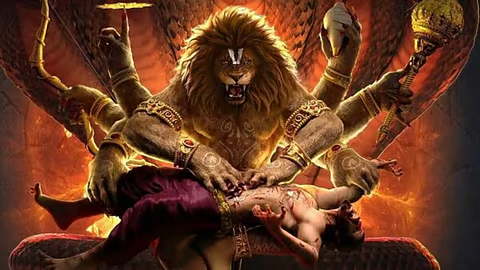
This wasn’t a film with a massive budget, a star-studded cast, or splashy promotions. Instead, it was a devotional, emotional, visually rich animated retelling of one of India’s most beloved mythological avatars — Narasimha, the half-lion, half-man incarnation of Lord Vishnu.
Against all expectations, and despite releasing alongside major live-action blockbusters, Mahavatar Narasimha shocked the entire industry by collecting 100 crores gross worldwide on a modest 15-crore budget. This is more than a hit — it is a phenomenon. It is a moment that marks the arrival of a brand-new wave of devotional animation storytelling in India.
And the man behind this revolution? Ashwin Kumar, a visionary filmmaker who believed that animation is not just for children — but a powerful medium for mythology, spirituality, and timeless emotion.
With the massive success of the first film, the director has already announced the next ambitious chapter: Mahavatar Parashurama, slated for release in 2027. The Mahavatar Cinematic Universe is officially rising — and India is watching closely.
Let’s explore how this universe began, why it succeeded, and what the future holds.
Mahavatar Narasimha: A Devotional Explosion That No One Saw Coming
When the film was first announced, many assumed it would be a niche experiment — a devotional animated film releasing in a landscape dominated by star-driven action movies. But Ashwin Kumar had a different vision altogether.
He wanted to create a cinematic universe rooted in Purity, Devotion, Visual Artistry, and Emotional Storytelling.
✔️ Low budget
✔️ No big star voice cast
✔️ Unconventional release timing
✔️ Animated format — a first for devotional mythology
Yet the film became a tidal wave.
Why did Mahavatar Narasimha succeed?
1. Storytelling rooted in emotion
The film didn’t just narrate the well-known mythological tale. It brought alive the anguish, devotion, and divine fury with humanized emotion.
2. Deep spiritual music that touched hearts
The soundtrack became one of the biggest surprise hits of 2025. Every bhajan, every devotional melody carried an emotional weight that connected across generations.
3. Beautiful animation work
The visuals were rich, detailed, and artistic — blending traditional temple art forms with modern animation techniques.
4. Family audience acceptance
For the first time in decades, families rushed to theaters not for entertainment, but for devotional experience.
5. Word of mouth
The biggest victory was the organic love the film received. Theatres saw unprecedented repeat audiences.
This film proved that devotion + animation = powerful cinema.
Ashwin Kumar – The Visionary Who Started India’s First Animated Mythology Universe
Director Ashwin Kumar deserves massive credit for taking the kind of risk that most filmmakers wouldn’t dare to attempt.
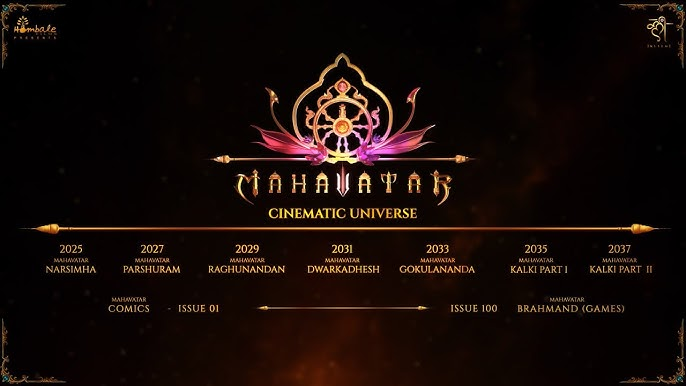
✔️ He created India’s first mythological animated universe
✔️ He chose devotion over commercial masala
✔️ He trusted artistic purity more than formula
✔️ He delivered a 100-crore blockbuster from a 15-crore film
In interviews, he described the project as:
“A cinematic offering, not just a movie.”
And audiences agreed.
Ashwin Kumar’s vision has now expanded into a full Mahavatar Cinematic Universe, where each avatar of Vishnu will be brought to life with:
- Emotional storytelling
- Beautiful background score
- Artistic animation
- Mythological accuracy
- Deep spiritual symbolism
This is not simply a movie universe — it is a spiritual storytelling revolution.
Mahavatar Parashurama (2027): The Next Big Chapter
After the thunderous success of Narasimha, Ashwin Kumar wasted no time announcing the next film:
⭐ Mahavatar Parashurama – releasing in 2027
The sixth avatar of Vishnu is one of the most powerful and complex mythological figures — part sage, part warrior, and entirely divine.
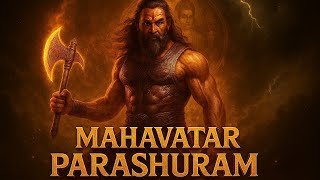
This chapter is expected to explore:
- Parashurama’s inner conflict
- His 21 battles against injustice
- His devotion to his parents
- His incredible strength and divine fury
- His role as a mentor to great warriors
While Narasimha focused on divine protection, Parashurama will explore divine justice.
Why Parashurama is the perfect follow-up:
- Fierce action potential
- Spiritual depth
- A rarely explored myth in cinema
- Huge audience curiosity
- Strong personality-driven narrative
Ashwin Kumar is reportedly increasing the technical scale:
- Higher animation quality
- More detailed character movements
- Larger world-building
- Better soundscapes
- Stronger visual symbolism
Mahavatar Parashurama is expected to be bigger, deeper, and more emotionally powerful.
Why the Mahavatar Cinematic Universe Matters
India has seen cinematic universes before:
- LCU
- Cop Universe
- Spy-Verse
- Horror-Comedy Universe
But Mahavatar CU stands apart for three reasons:
⭐ 1. It is India’s first animated cinematic universe
No other Indian filmmaker has attempted a mythology universe in pure animation form.
⭐ 2. It is deeply rooted in devotion and purity
Rather than focusing on commercial formulas, it brings spiritual emotion to mainstream cinema.
⭐ 3. It proves that animation is not limited
India now looks at animated films with respect—not as children’s content, but as cinematic art.
This universe may inspire:
- Future devotional films
- Animated mythological series
- Artistic cultural storytelling
- More experimentation across industries
Mahavatar CU is not just a trend — it is a foundation for a new Indian genre.
Conclusion: A Universe Born From Faith, Passion, and Vision
Mahavatar Narasimha did not just create box office magic — it showed Indian cinema a new path.
The film’s emotional depth, devotional presentation, and artistic beauty made it a modern cultural milestone.
With Mahavatar Parashurama (2027) now on the way, this cinematic universe promises:
- Larger stories
- Higher emotion
- Deeper devotion
- Better artistic craft
- A powerful spiritual journey across avatars
India’s first animated cinematic universe is here.
And it is just beginning.
Explore More on TFI.Buzz
- Bhadrakali Movie Review: A Gripping Political Revenge Drama With Strong Moments but Uneven Execution
- VARANASI: The Divine Wait Ends, The Era Begins – SSMB29
- What Is the Secret Link Between Saaho and OG? The Big Theory Fans Can’t Stop Talking About
- Ustaad Bhagat Singh First Single on the Way: A December Feast for Pawan Kalyan Fans
- Rajasaab First Single: Mass Blast or Romantic Vibe? The Prabhas Storm Is Ready to Begin
- Rise of the Indian Cinematic Universes: How Every Industry Is Building Its Own Connected World
- Ramayana 2027: India’s Biggest Film Ever – Ranbir, Yash, Sai Pallavi & Sunny Deol Unite for a 4000-Crore Epic
- SSMB29 – Varanasi: Rajamouli’s Global Vision Begins as Abhay Ram Joins the Epic and Hanuman Casting Expands Across India
Stay connected with TFI.Buzz for authentic insights, reviews, and updates straight from the world of Indian cinema.
Leave a Reply